

Analysis
Consensus Is Sort of Like True Love
Ali Houshmand took Rowan University from five colleges to fifteen, and from no medical school to three.
Oct 6, 2026 · 5 min read
Analysis
In times of profound social and labor transformations, universities must rethink their role in the contemporary world.
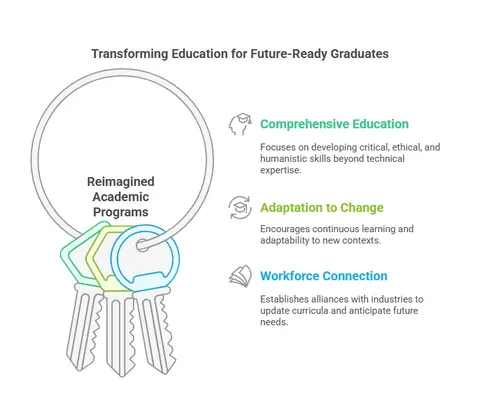
In times of profound social and labor transformations, universities must rethink their role in the contemporary world. Artificial intelligence, digital transformation, and the rapid changes in the labor market are reshaping how we live, work, and learn. These phenomena invite us to reflect on the essence of higher education and its responsibility in shaping ethical, critical, and culturally enriched citizens.
Now more than ever, universities must go beyond the mere transfer of technical knowledge. The education of well-rounded individuals, knowledgeable in philosophy and history, capable of reading deeply, arguing rigorously, and reflecting autonomously, should be a cornerstone of their mission. This comprehensive approach not only addresses the need to cultivate critical thinking but also underscores the urgency of instilling values that guide the construction of a more just and compassionate society.
A report by the McKinsey Global Institute projects that by 2030, millions of workers will need to change jobs, often transitioning to sectors that do not yet exist. This phenomenon illustrates a critical concept: universities, in many cases, are beginning to prepare students for a market that is not yet fully defined. However, they also bear the responsibility of equipping future professionals to meet the current demands of the labor market while preparing for the changes to come. This delicate balance between present and future needs could be termed "Dual Adaptation," where universities act as a bridge between today and the transformations ahead.
To address this gap, universities must reimagine their role by designing academic programs that balance three pillars:
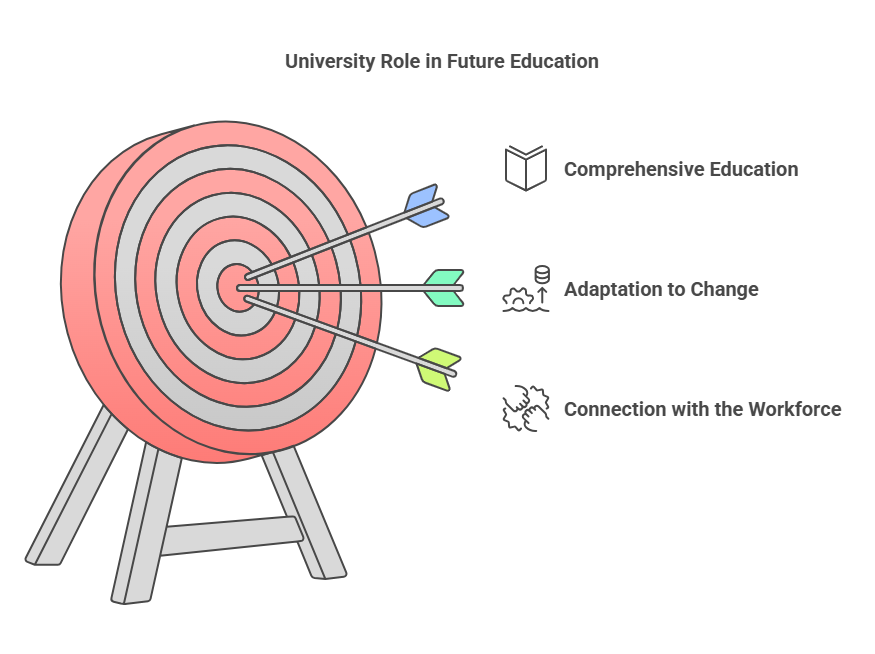
In a world where technical skills quickly become obsolete, teaching students how to learn and think is more important than teaching technicalities. As psychologist Herbert Gerjuoy, quoted by Alvin Toffler in Future Shock (1970), observed: "The illiterate of the 21st century will not be those who cannot read and write, but those who cannot learn, unlearn, and relearn." This continuous learning must be the guiding principle for universities, connecting students to the demands of the present while keeping an eye on the challenges of the future.
The university of the future cannot be limited to being a space for knowledge transfer. It must become a driver of innovation and change, capable of anticipating market demands while simultaneously promoting values that guide the development of a more equitable society.
EdUp Editorials
This is where our team writes down what the conversations reveal. New editorials are published weekly.
More editorialsAnalysis
Ali Houshmand took Rowan University from five colleges to fifteen, and from no medical school to three.
Oct 6, 2026 · 5 min read
Analysis
Colleges and universities continue to waste significant amounts of space, according to recently released results from the Inside Higher Ed/Hanover Research Survey of College and University Chief Business Officers.
Oct 1, 2026 · 6 min read

Analysis
Welcome back to EdUp Editorials! If you tuned into our latest live event, you know we took a deep dive into the complex, fascinating, and often invisible world of university administration.
Aug 4, 2026 · 7 min read