
Analysis
Consensus Is Sort of Like True Love
Ali Houshmand took Rowan University from five colleges to fifteen, and from no medical school to three.
Oct 6, 2026 · 5 min read
Analysis
Higher education has become a space where courage feels risky, and hesitation feels safe.

Higher education has become a space where courage feels risky, and hesitation feels safe.
Across the sector, presidents and provosts are being asked to do more with less—less certainty, less funding, and less time to adapt. The question that keeps showing up in my own leadership circles is this: How do you move forward when it feels like everything around you is pausing or retreating?
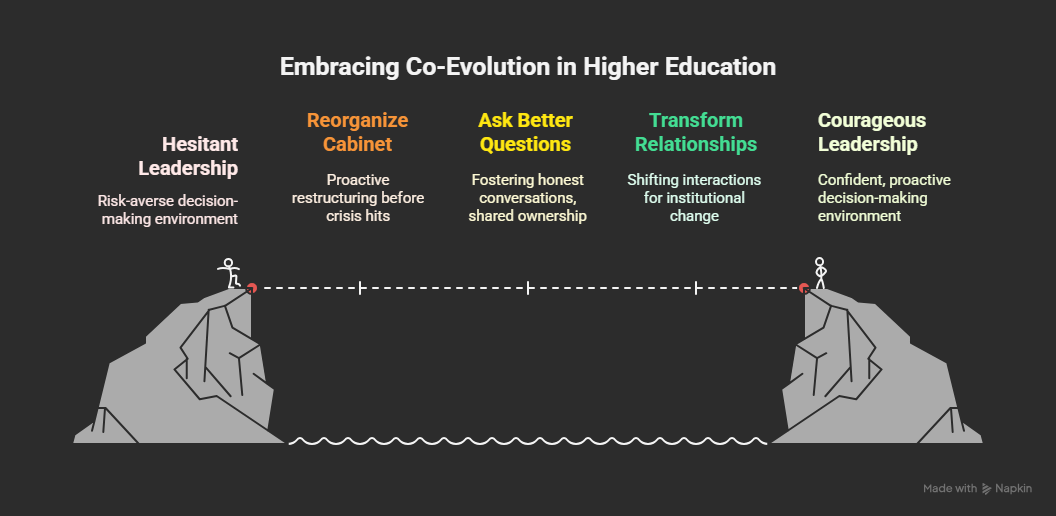
At Tiffin University, we don’t claim to have solved this. But over the past year, we leaned into a leadership approach I’ve come to call co-evolution—a simple idea with complex implications: if we want systems to evolve, our people must evolve with them. And vice versa.
What happened when we centered that principle in our strategy surprised even us.
In September 2023, we reorganized our Cabinet. It wasn’t because we were in crisis. It was because we knew how we operated wouldn’t serve the institution we were trying to become.
That change—hard, messy, and full of unknowns—became a catalyst for structure and mindset. We started asking better questions: How can we build a leadership team that acts instead of reacts? How do we create space for honest conversations and shared ownership? What would it look like to trust the process before we saw the results?
Leadership, at its core, is a relational act. And if we want to transform our institutions, we have to start by transforming how we relate to one another.
Fall 2024 brought signs that we were heading in the right direction—not just in sentiment, but in substance:
But the numbers are not the story. The story is what enabled those numbers.
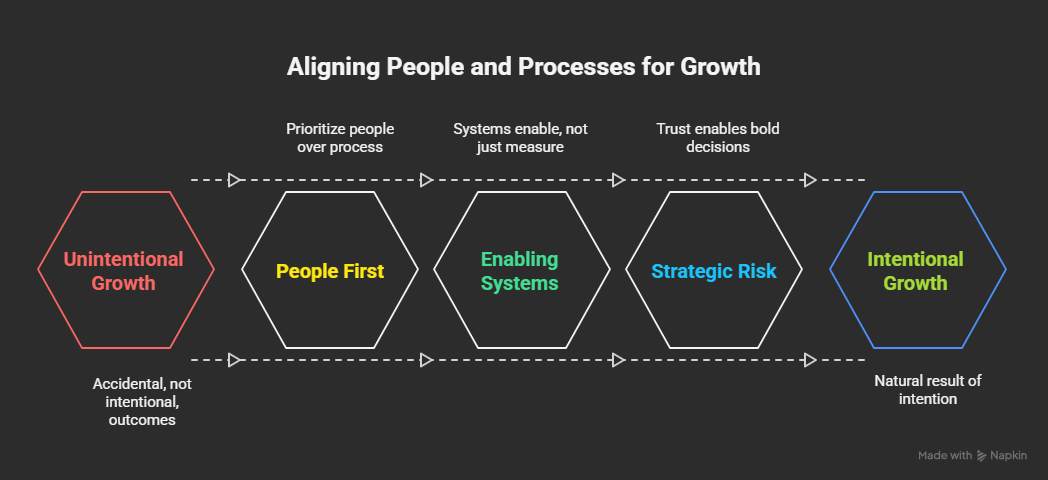
More than anything, we saw a team that began to move differently—more collaboratively, nimbly, and boldly because we invested in the ecosystem around them. We asked our systems to work for people, not the other way around.
That’s the heart of co-evolution: when you align people and processes toward a clear purpose, growth is no longer accidental. It becomes the natural result of intention.
I hesitate to call these principles because we’re still learning. But here are three ideas that have anchored us—each part of a story that taught us how people, systems, and trust work together in practice:
A few years ago, I noticed something troubling: our institutional aid was quietly creeping up, even as our net tuition trended downward. Instead of reacting with immediate solutions, I began with a question: What are we not seeing here? That question led to a series of conversations—not just with finance, but with enrollment, athletics, and academic leadership. It would have been faster to issue a directive. But we chose the slower, harder route of shared inquiry. And in doing so, we created the conditions for honesty and ownership to emerge.
As the team dug into the issue, we discovered that our athletic scholarship model, though built with good intentions, was creating imbalances that no one system had flagged on its own. The problem wasn’t any single person or policy—it was that our processes weren’t built to reveal this kind of cross-functional friction. Once we surfaced it, we didn’t just tweak the aid formula. We asked: How do we create systems that help us ask the right questions earlier? That led to changes in how we model financial scenarios and how decisions are shared across teams—not to enforce control, but to unlock clarity.
Rebalancing our aid strategy wasn’t a small decision. It impacted recruitment, athletics, and the budget model. But by the time we reached that crossroads, something had shifted: we trusted each other. The process of uncovering the issue had built new relational capital. No one had been scapegoated. Everyone had contributed. And that made it possible to move forward boldly—knowing we were aligned not just in goals, but in how we chose to lead.
These weren’t silver bullets. They were directional choices. And they created enough space for real change to take root.
I’ve come to believe that the biggest threat facing higher education right now isn’t declining enrollment. It’s declining nerve.
We’re in a moment where the safe thing to do feels like saying less, doing less, cutting more. But nothing about this moment calls for less. It calls for more clarity, more empathy, and more courage to evolve before we’re comfortable.
At Tiffin, we’re still in process. We’re still asking questions. But we’re also moving. And that, more than any single initiative or outcome, is what gives me hope.
This is not a blueprint. This is a reflection.
If you’re leading an institution through uncertainty, I’d encourage you to ask:
We won’t lead the sector forward by being louder. We’ll do it by being braver.
And it starts, I believe, with co-evolution.
EdUp Editorials
This is where our team writes down what the conversations reveal. New editorials are published weekly.
More editorialsAnalysis
Ali Houshmand took Rowan University from five colleges to fifteen, and from no medical school to three.
Oct 6, 2026 · 5 min read

Analysis
Colleges and universities continue to waste significant amounts of space, according to recently released results from the Inside Higher Ed/Hanover Research Survey of College and University Chief Business Officers.
Oct 1, 2026 · 6 min read

Analysis
Welcome back to EdUp Editorials! If you tuned into our latest live event, you know we took a deep dive into the complex, fascinating, and often invisible world of university administration.
Aug 4, 2026 · 7 min read